

Checking A Classic Power Supply
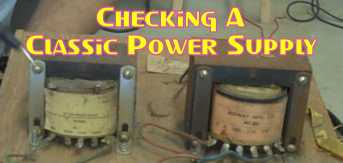
While switching power supplies are the standard in newer arcade games, classics such as Ms. Pac Man and Centipede originally had non-switching, linear power supplies that can be quite intimidating at first glance. These classic (or old school) power supplies usually look like a brick located at the bottom of your cabinet and can be difficult to work with due to years of wear and tear. In this post, we will discuss how to check the voltage coming out of your classic power supply as well as how to check the voltage on your board at the harness connection.
Checking A Classic Power Supply

First off, we want to identify where our classic power supply is in our cabinet. These power supplies are typically located at the bottom of the cabinet and resemble a brick-like structure. They should have AC voltage coming into of the bottom of one side either directly from the wall or from an AC filter. The opposite side should contain the AC voltages that go out to the board and other cabinet parts such as coin lights. Be careful not to mistake your isolation transformer with your power supply. Isolation transformers can look very similar to classic power supplies except for the fact that they usually have two wires coming into the bottom for AC input from the wall or AC filter and two coming out of the top (usually on the same side) for AC output to the monitor.
If you just see one brick-like structure in the bottom of you cabinet it could be that you have a dual power supply/isolation transformer unit. If this is the case then the bottom of both sides should have AC input lines with the top of one side putting out multiple AC voltages to the board and the top of the other side putting out AC voltage to the monitor. While these dual units are not as common, they are certainly something to be aware of in case you run across one.
Once we have located the power supply in our cabinet, we can begin the process of checking the voltages. Let’s start off by setting our multimeter to the AC voltage setting. Now we must identify which of our contact points are grounds and which ones hold voltages. Our ground wire in the video is indicated by a 0V (Zero Volts) marking on the power supply label. Most of these power supplies were labeled at one time or another, however, age and normal wear and tear usually leave them in an unreadable state. If you cannot identify which wire is the ground wire, we recommend placing the black probe of your multimeter on the AC ground coming from the wall. This AC ground is usually easier to locate (it’s usually the green wire on the AC filter) than the AC ground on the transformer and allows us to check the contact points safely with our red probe. This is a much better alternative than randomly touching contact points to see if we can locate the ground wire.
Something to keep in mind when checking our classic power supply is that not all of them put out the same voltage. For example, a Ms. Pac Man usually puts out 7 VAC while other games might use a higher voltage because of the other cabinet parts that use that particular line. If you find that your power supply is giving off higher voltage than what the manual for the game shows then you might try checking the voltage where the board connects to the harness. This can usually be accomplished by finding the ground and AC voltage pins on your harness (via your manual) and placing your multimeter probes on these points. Your board might have easily accessible contact points that you can place your probes on for testing. Whatever way you decide to check the voltage going to your board, performing this check allows you to make sure your board is not just getting power but the correct voltage.
You might also notice some fuses located in the bottom of your arcade cabinet around the power supply. While you can certainly check these in the traditional manner that we discuss in our post on Checking Fuses With A Multimeter, you can also check them with the game on by placing your black probe on a ground point and the red probe on the other side of the fuse. If voltage is flowing through the fuse then you know that it is good. Also, make sure that you are careful when working with an arcade game that’s plugged in. Always take the necessary measures to make sure you are safe when working in these situations.
Like we discussed in our post on Checking And Replacing A Power Supply, most arcade boards use DC power. Before switching power supplies became popular, different arcade manufacturers would use different methods to convert the incoming AC power to DC. For example, a Ms. Pac Man board takes in AC power from the power supply (or transformer) and converts it to DC voltage for use by the logic circuits and audio amplifier. Of course, you can also hook up DC voltage directly to the board so that the board does not have to convert it. As you can see from these Ms. Pac Man pinouts on MikesArcade.com, there is both an AC and DC wiring configuration. Many Atari arcade games such as Centipede have an AR (Audio Regulator) board that regulates the voltage coming in from the power supply then passes it along to the main board. The AR board also acts as an audio amplifier for these games and can be the cause of audio problems you might be having with your Atari arcade games. The AR board should have test points on it that allow you to check to see if your voltage is correct. If you suspect that your AR board might be having issues, Bob Roberts sells repair kits that can restore it’s functionality.
Most of the arcade games that people consider classics such as Ms. Pac Man and Centipede did not have the benefit of switching power supplies when they were produced. As such, having the skills to check a classic power supply can be a very valuable as you work on these older arcade games. Please let us know if you have any questions or suggestions by leaving them in the comments section below.


I’m working on a 1993 midway NBA jam TE cab that appears to have the fabled isolation transformer/switching power supply combo. AC lines run into it from an AC filter. It isolates 120 v for the monitor and 120 v for the switching power supply, as well as 5.9 for the coin door lights and what the schematic seems not to want to specify for the light fixture. I need to know how to replace this part or if i even need to. It takes 119.6 v and puts out 132 v to the monitor and switching supply. the switching supply (brand new on I put in) will not light up and takes that 132 v AC and puts out DC – .6v for the -5v and 1.96v for the +5v and then like 2v for the +12v. These are the same on the jamma harness and the CPU doesn’t light up either. will replacing that combo unit with one that puts out 120 fix this issue and give power to the CPU again? Also the monitor comes on now that I stuck a cap kit in it, but–I think because of the 132 v coming to it– it shows up solid white. This may also be because there is no signal from the board.
Cameron,
Sounds like you are having some wiring trouble. The best advice we can give you is to get a new power supply and perhaps even a new isolation transformer and rewire your cabinet. You can order these part from Bob Roberts (http://www.therealbobroberts.net) for fairly cheap. We believe that Bob also sells a complete cabinet bottom which includes the power cord, isolation transformer, power supply and more for one price. This might be a better way to go if you don’t want to fool with wiring that yourself. Check out our posts on Checking And Replacing A Power Supply and Checking A Classic Power Supply for more information.
We have also featured your question on episode 14 of our Q&A podcast. Please listen to it for more of our thoughts on your question. Thank you for your question and keep us updated on your progress.
My OLD galaga machine was fried by a recent lightning strike of a tree near my home. Now the machine will not power on ? Any suggestions or is it just toasted?
Brian,
With any luck, the lightning strike that your Galaga machine received just popped a fuse and didn’t damage your power supply. Check your fuses to make sure that this is the case. If your fuses are good or you replace the fuses and it still doesn’t power on, check the power supply to make sure that it is functioning properly. You can also check your power cord and plug to see if there are any burned parts that might be causing inconsistent power issues.
We have also featured your question on episode 19 of our Q&A podcast. Please listen to it for more of our thoughts on your question. Thank you for your question and good luck with your repair.
pacman boards are known for having burned contacts. i was wondering if the ac voltage and not dc going to the board is the cause of that. would going to a switching power supply eliminate this problem. thanks
John,
This is a great observation. We really haven’t thought about that before but we know that every Pac Man that we’ve installed a switching power supply in has not created the burned contact problem. Perhaps there is someone out there that can shed a little more light as to why this is the case. If it is true, this is just another reason to convert your older arcade games over to switching power supplies.
We have also featured your comment on episode 22 of our Q&A podcast. Please listen to it for more of our thoughts on this issue. Thank you for your comment and good luck with your future repairs.